




Stanton Chase’s C-Suite Bench Test gives boards, CEOs, and CHROs six questions for checking whether a succession plan would hold up if a senior executive left tomorrow. Bill Brewer, Christian Ehl, and Sundar Rajan Ramalingam argue that readiness should be judged against the mandate the business will set over the next three to five years, not against reputation. They separate performance, potential, and readiness, and they show how one promotion can open a second vacancy elsewhere on the leadership team. The article also explains why development needs a named owner and why executive onboarding belongs inside succession planning.
A succession plan is only as useful as the evidence that its named successors can lead the business the company is becoming.
If your CEO or another critical executive left tomorrow, who would assume responsibility? What evidence demonstrates that person is prepared? What leadership gap would the appointment create elsewhere?
These questions distinguish a succession chart from an executable succession plan.
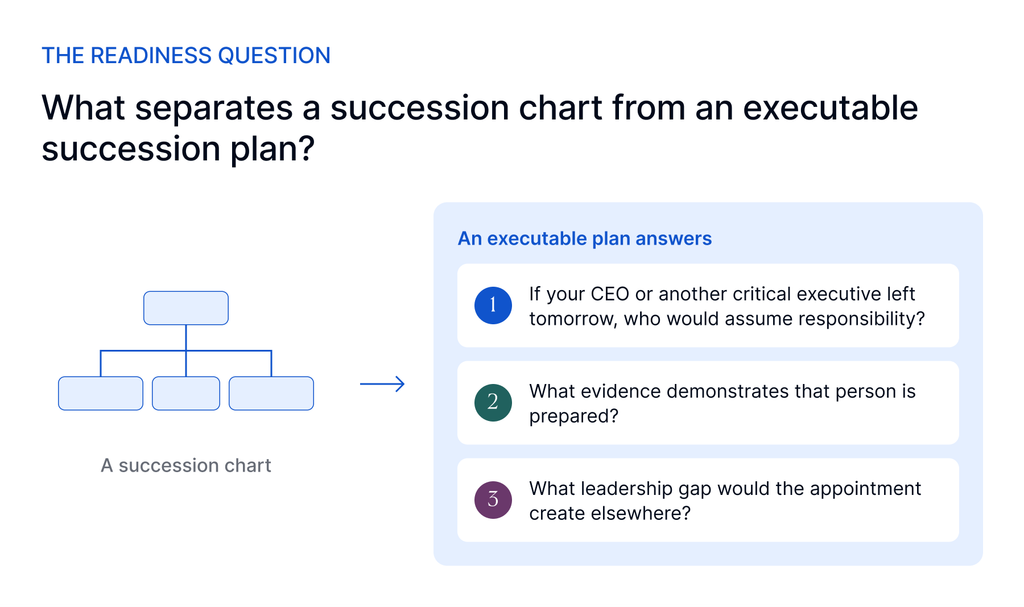
The central issue is readiness. Identifying potential successors is a starting point. Preparing them to lead requires clarity about the business ahead, evidence of their capabilities, and deliberate action to close the gaps.
For boards, CEOs, and CHROs, the question is not simply, “Who is next?” It is, “Who is prepared for what comes next?”
What Should a Succession Plan Define Before It Names Candidates?
Succession discussions can become anchored to familiar names. A respected executive performs well, earns the CEO’s confidence, and becomes the presumed successor. But readiness must be assessed against the requirements of the next role, not reputation alone.
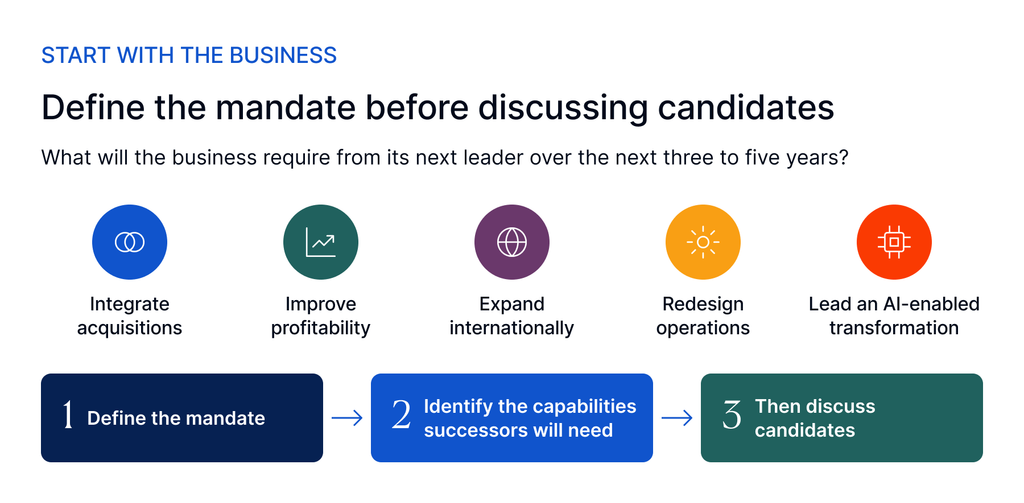
Begin by defining what the business will require over the next three to five years. Will the next leader need to integrate acquisitions, improve profitability, expand internationally, redesign operations, or lead an AI-enabled transformation?
Gartner’s succession-planning guidance recommends prioritizing roles according to their importance to current and future strategy, then identifying the capabilities successors will need. It also cautions against defining requirements solely around the current job structure.
The practical implication is straightforward: define the mandate before discussing candidates. Otherwise, the organization risks preparing someone for a role that is changing.
How Do Performance, Potential, and Readiness Differ in Succession Planning?
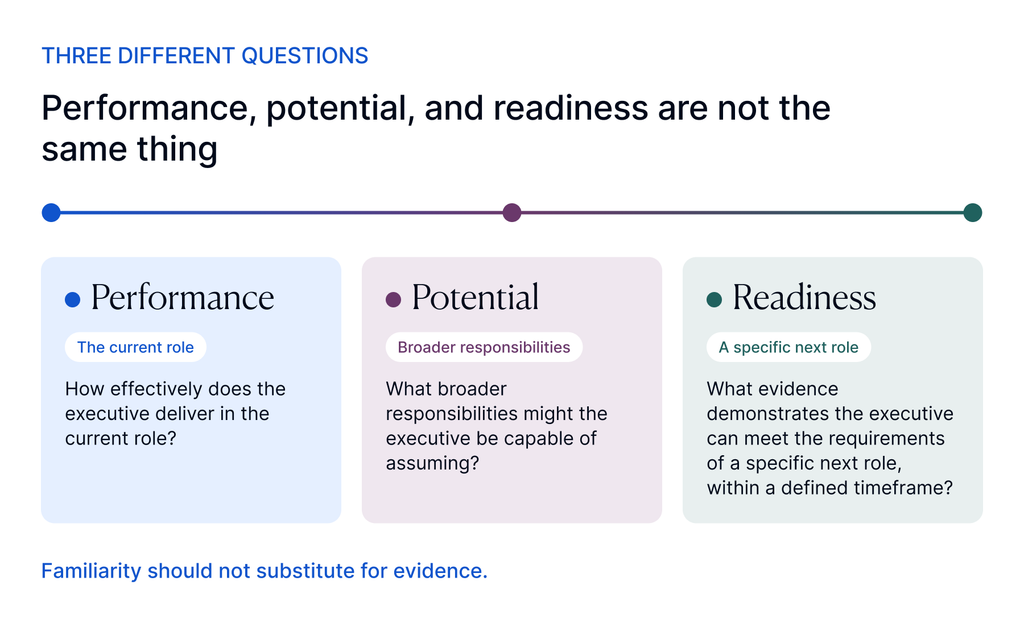
These three concepts answer different questions:
- Performance: How effectively does the executive deliver in the current role?
- Potential: What broader responsibilities might the executive be capable of assuming?
- Readiness: What evidence demonstrates the executive can meet the requirements of a specific next role, within a defined timeframe?
A strong functional leader may still need experience making enterprise-wide tradeoffs. A successful business-unit president may need greater exposure to capital allocation, investors, or board relationships before assuming the CEO role.
Ask what candidates have demonstrated under relevant conditions. Have they led through uncertainty? Managed competing priorities? Built leadership capacity beyond their own function? Made difficult decisions with incomplete information?
McKinsey’s research on succession bias warns that similarity bias can favor candidates who resemble incumbent leaders. Its recommended response includes structured discussion of selection criteria, broader input, and deliberate development opportunities.
Familiarity should not substitute for evidence. Neither should a “ready now” designation without a clear explanation of what the candidate is ready to do.
Why Should CEO Succession Planning Cover the Whole C-Suite Bench?
CEO succession deserves board attention, but leadership continuity extends across the executive team.
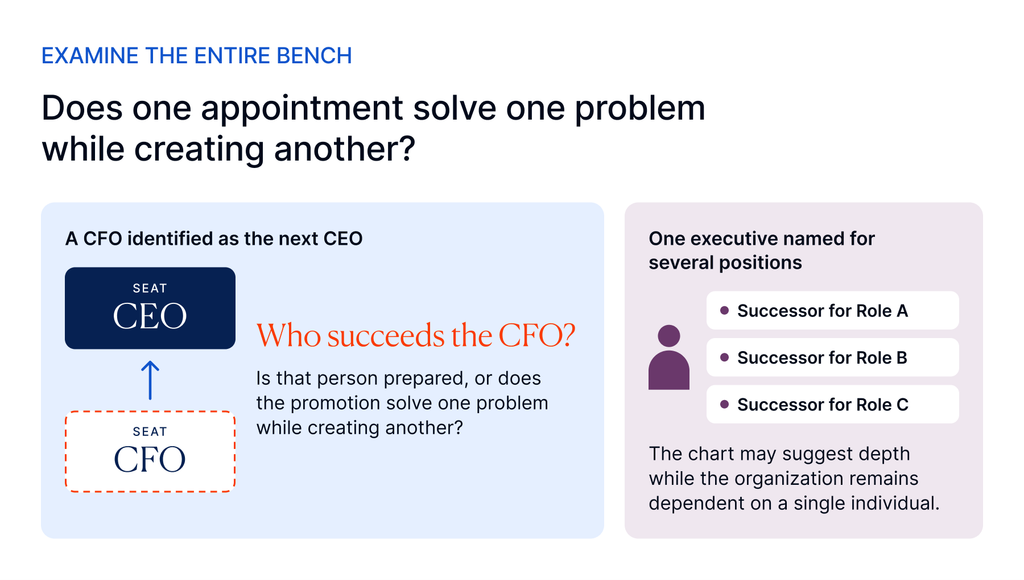
Consider a CFO identified as the next CEO. Who succeeds the CFO? Is that person prepared, or does the promotion solve one problem while creating another?
The same issue arises when one executive appears as a successor for several positions. The chart may suggest depth while the organization remains dependent on a single individual.
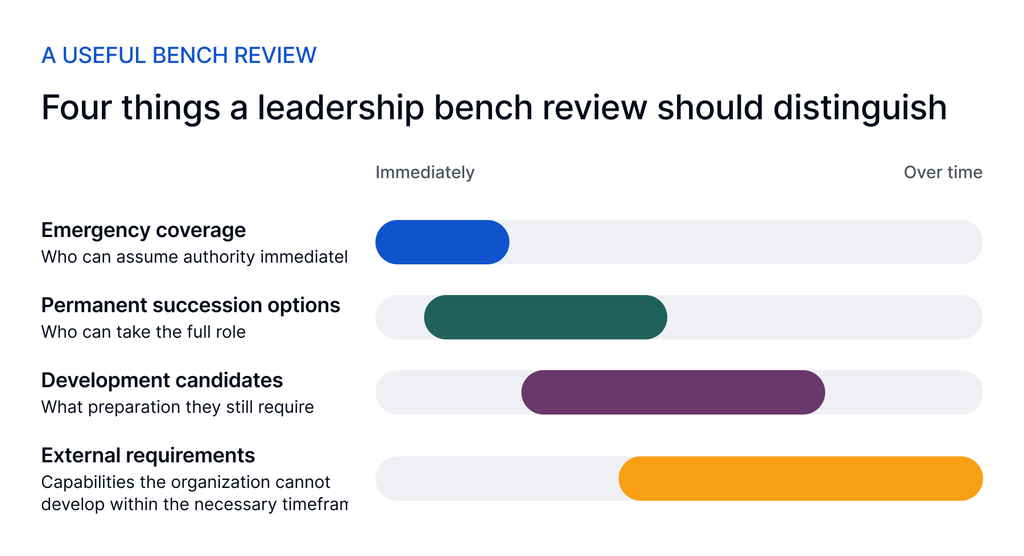
A useful review should distinguish:
- Emergency coverage, including who can assume authority immediately.
- Permanent succession options, including who can take the full role.
- Development candidates, including what preparation they still require.
- External requirements, including capabilities the organization cannot develop within the necessary timeframe.
Candidate interest also matters. Gartner recommends open discussions about future roles, so that development balances organizational needs with each leader’s career aspirations. A succession plan should not assume availability or ambition that has never been discussed.
How Can Leadership Teams Turn Assessment Findings Into Development Decisions?
An assessment has limited value unless it changes what happens next.
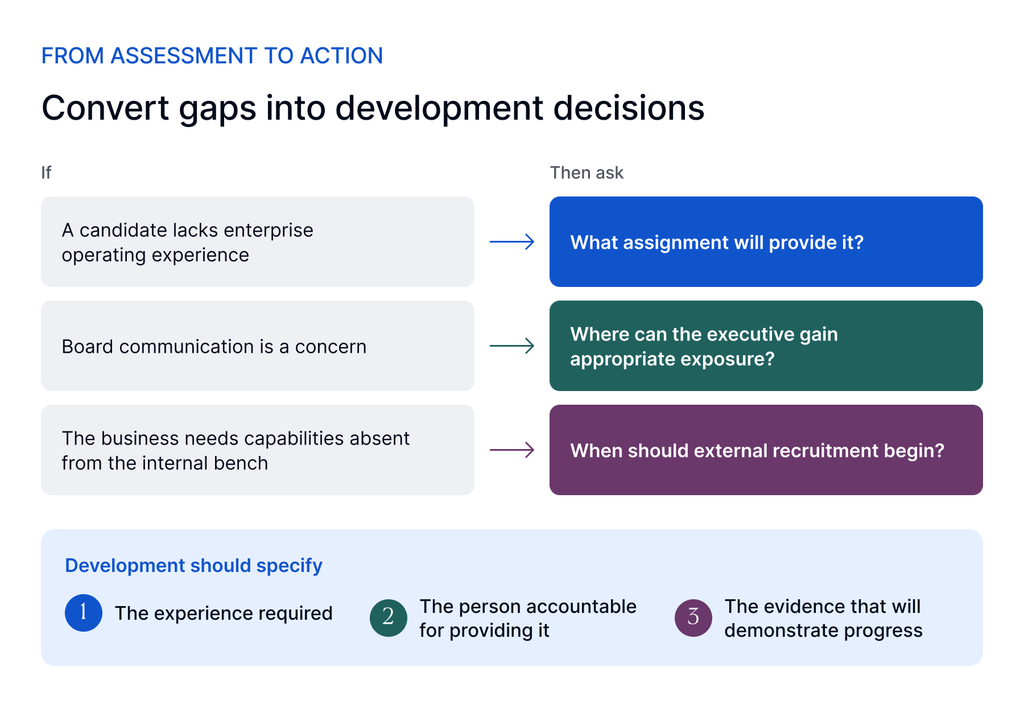
If a candidate lacks enterprise operating experience, what assignment will provide it? If board communication is a concern, where can the executive gain appropriate exposure? If the business needs capabilities absent from the internal bench, when should external recruitment begin?
Development should specify the experience required, the person accountable for providing it, and the evidence that will demonstrate progress.
McKinsey identifies job rotations, stretch assignments, and mentoring as ways to prepare internal candidates within a structured succession process. The assignment, however, should address an identified requirement, not simply add activity to a development plan.
The CHRO can help translate broad judgments into specific actions, timelines, and reassessment points.
Why Does Executive Onboarding Belong in Succession Planning?
Selecting the successor does not complete the work.
Internal candidates know the organization, but their authority, relationships, and responsibilities change when they assume a larger role. External appointments require additional preparation around organizational context and stakeholder expectations.
Transition planning should clarify the mandate, decision rights, early priorities, and measures of success. It should also define the outgoing executive’s responsibilities and boundaries.
Knowledge transfer matters, but so does alignment. The board, CEO, successor, and executive team should understand what must continue, what must change, and how disagreements will be resolved.
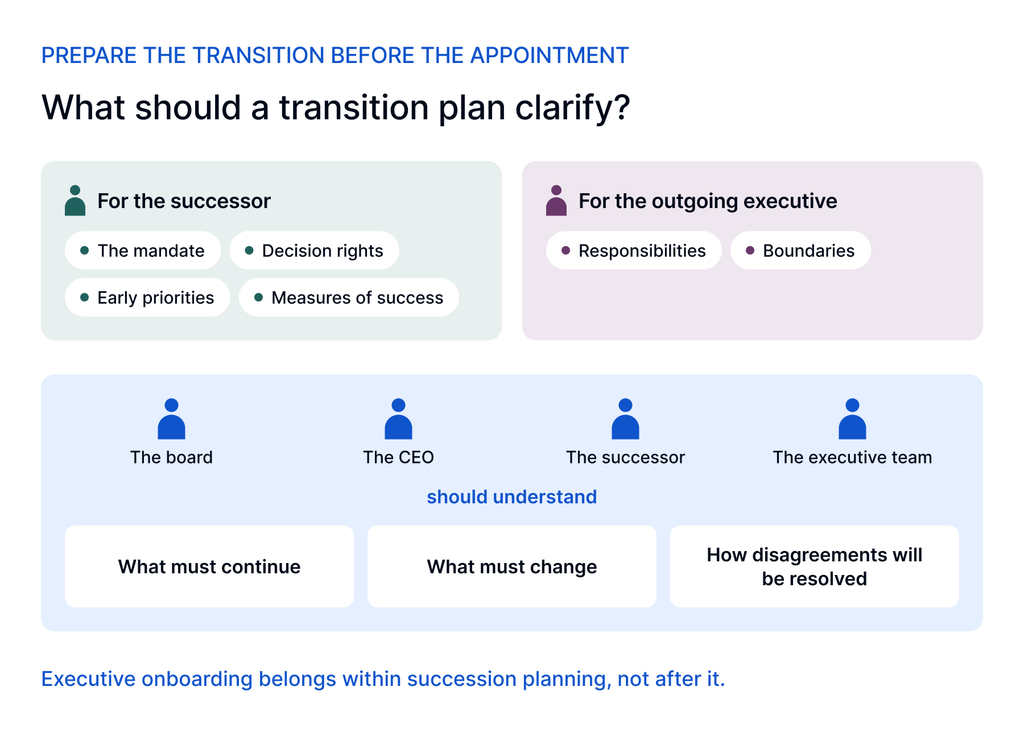
Executive onboarding belongs within succession planning, not after it.
What Is the C-Suite Bench Test for Succession Readiness?
Boards and executive teams can use six questions to challenge the substance of their plans:
- Future mandate: Have we defined what each critical leadership role will require as the business changes?
- Demonstrated readiness: What evidence supports our assessment of each potential successor?
- Emergency coverage: Who can assume authority immediately, and with what limitations?
- Bench depth: Where would an appointment create another gap or expose dependence on one person?
- Development action: What specific experiences will close the remaining gaps, and by when?
- Transition preparation: What must be in place for the successor to assume responsibility effectively?
These questions are a discussion framework, not a scoring instrument. Their value lies in exposing assumptions and identifying decisions.
Who Is Responsible for Succession Readiness: the Board, the CEO, or the CHRO?
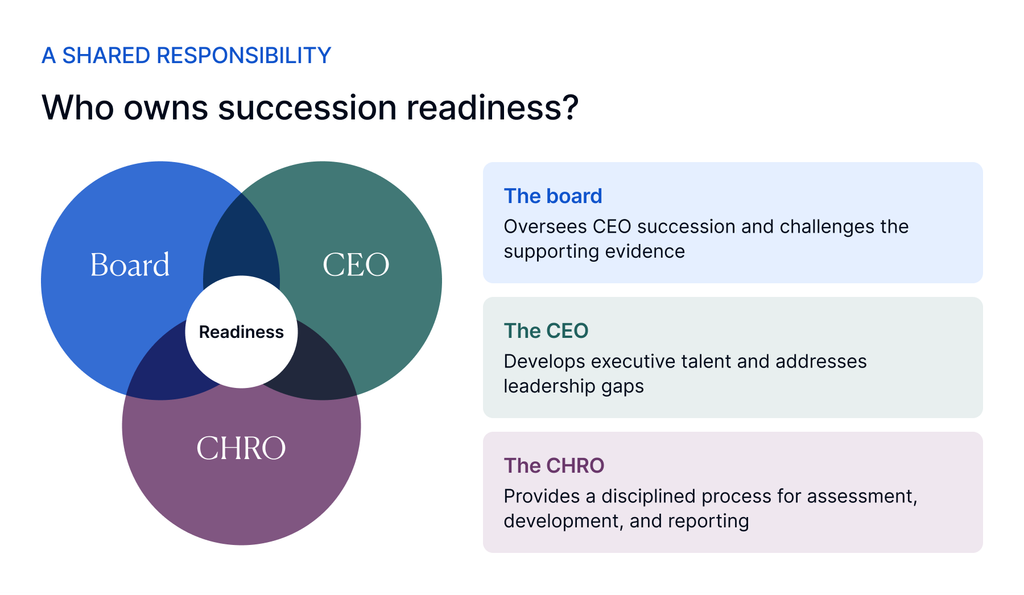
The board should oversee CEO succession and challenge the supporting evidence. The CEO should develop executive talent and address leadership gaps. The CHRO should provide a disciplined process for assessment, development, and reporting.
Start with one critical role. Examine its future requirements, available successors, development gaps, and transition arrangements. Then ask whether the plan could withstand an actual departure.
The measure of a succession plan is not how many names it contains. It is whether the organization has credible leadership options, understands the remaining gaps, and acts before a transition makes those gaps urgent.
About the Authors
William Brewer, CCP, is a Managing Director at Stanton Chase Los Angeles. He serves as the firm’s Global Functional Leader for Human Resources and its Global Advisory Leader for Executive Onboarding, and he is a member of the Stanton Chase CEO Search and Succession practice. Bill advises boards and CEOs on the assessment, selection, succession, and onboarding of senior leaders, including CEOs, CHROs, chief people officers, and other members of the C-suite.
Before joining Stanton Chase, Bill served as Chief Human Resources Officer for InSight Health, Epicor Software, and Alorica, organizations ranging from 3,000 to 20,000 employees. Earlier in his career, he held human resources leadership roles with The Walt Disney Company and Fluor Corporation. Bill earned an MBA from the University of Redlands, where he taught at the School of Business for 17 years, and he is a Certified Compensation Professional through WorldatWork.
Christian Ehl is a Partner at Stanton Chase Düsseldorf and the firm’s Global Functional Leader for Sustainability and ESG. He works across the Industrial sector and with CFO and Financial Executives and Startups and Scale-ups. Christian has worked in recruiting since 2004, with international corporations and medium-sized businesses alike, and he often supports organizations as they create new roles, adapt existing ones, or bring in outside talent during a transformation.
Christian earned a coaching certification in systemic and change coaching in 2008. He holds a degree in International Business Administration from Accadis Business School and a further degree from the University of Newcastle in the UK.
Sundar Rajan Ramalingam is a Partner at Stanton Chase Baltimore, serving clients in Technology, Professional Services, and Industrial, as well as in Private Equity. He brings nearly three decades of leadership experience in manufacturing and global technology, during which he moved from HR leadership into general management with full profit and loss responsibility.
Before joining Stanton Chase, Sundar led a multi-billion-dollar global engineering capabilities division and helped set up several Global Capability Centers. He holds an MBA from XLRI Jamshedpur and completed the Chief Human Resource Officer Program at Wharton.
How Can We Help?
At Stanton Chase, we're more than just an executive search and leadership consulting firm. We're your partner in leadership.
Our approach is different. We believe in customized and personal executive search, executive assessment, board services, succession planning, and leadership onboarding support.
We believe in your potential to achieve greatness and we'll do everything we can to help you get there.
View All Services