



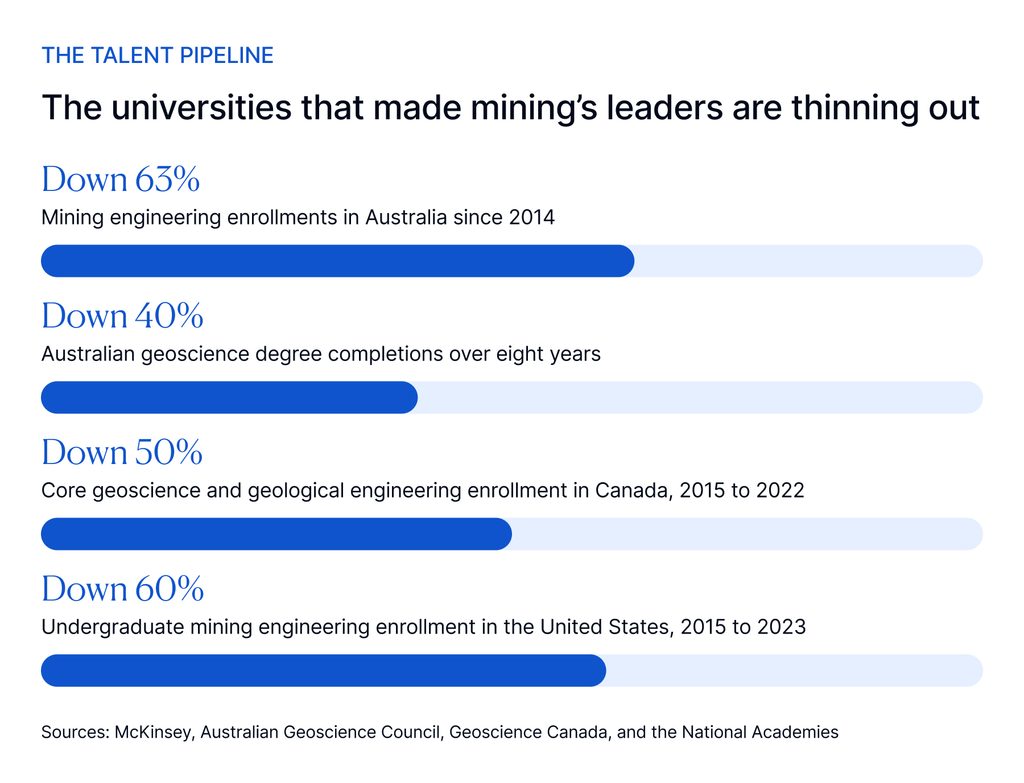
For decades, many mining leaders came from one of four countries: Australia, Canada, South Africa, or the United States. Their universities trained the geologists and mining engineers who became mine managers and then chief executives, and much of the rest of the industry hired from that pool. The pool is shrinking. Australian mining engineering enrollments are down 63% since 2014, Canadian core geoscience enrollments fell 50% between 2015 and 2022, and US mining engineering enrollment dropped 60% between 2015 and 2023. Meanwhile, the growth has moved. Latin America holds the largest share of global exploration spend and $151 billion of critical-mineral projects, Indonesia supplies most of the world’s new nickel, and the DRC most of its cobalt. Governments in these regions steer the industry directly, using processing mandates, export controls, and environmental regulation, or a mix of all three. Saudi Arabia alone is putting $110 billion behind listed but largely state-directed Ma’aden, whose plan is to grow tenfold by 2040. The map of where leaders are made and the map of where mining is growing do not match, and the capital behind the industry still sits on the ASX, TSX, LSE, and NYSE, so boards answer to shareholders in one set of countries while operating under states in another. The industry has responded by importing managers and by carving its leadership into regions. In EY’s latest survey, three quarters of executives admit they are not confident they can fill the roles their operations need. This article sets out the two maps and the responses so far, then makes the case for one response that serves shareholders and host communities at once: leadership that is technically and culturally aligned to the geology and the jurisdiction, built early and treated as part of the license to operate.
Mining’s leaders have long come from four countries of the political and economic West. Its growth now sits with the political and economic rest, and the next generation of leaders will have to train, grow, and manage on that world’s terms.
Countries outside the West’s institutions are asserting control over their own mineral wealth. The leaders of the next generation will train and operate in a more complex geopolitical and economically nationalist world than any since the end of the Cold War, and much of that will happen on terms dictated by the political and economic rest. The old system is not producing enough people for that world, and the people now reaching the top still come out of it.
When the world’s two largest gold miners appointed new chief executives within a month of each other in early 2026, one was an Australian and Canadian national and the other a South African engineer who grew up in a mining town in North West Province. Nationality is the point here, not the appointments. Both came up through one system. For decades, mining has filled much of its senior ranks from four countries with large domestic industries and renowned technical schools: Australia, Canada, South Africa, and the United States. That system produced today’s chief executives, and it is turning out fewer people every year, just as the industry’s growth moves to new jurisdictions with abundant resources and superb geology but often vastly different political systems and economic drivers.
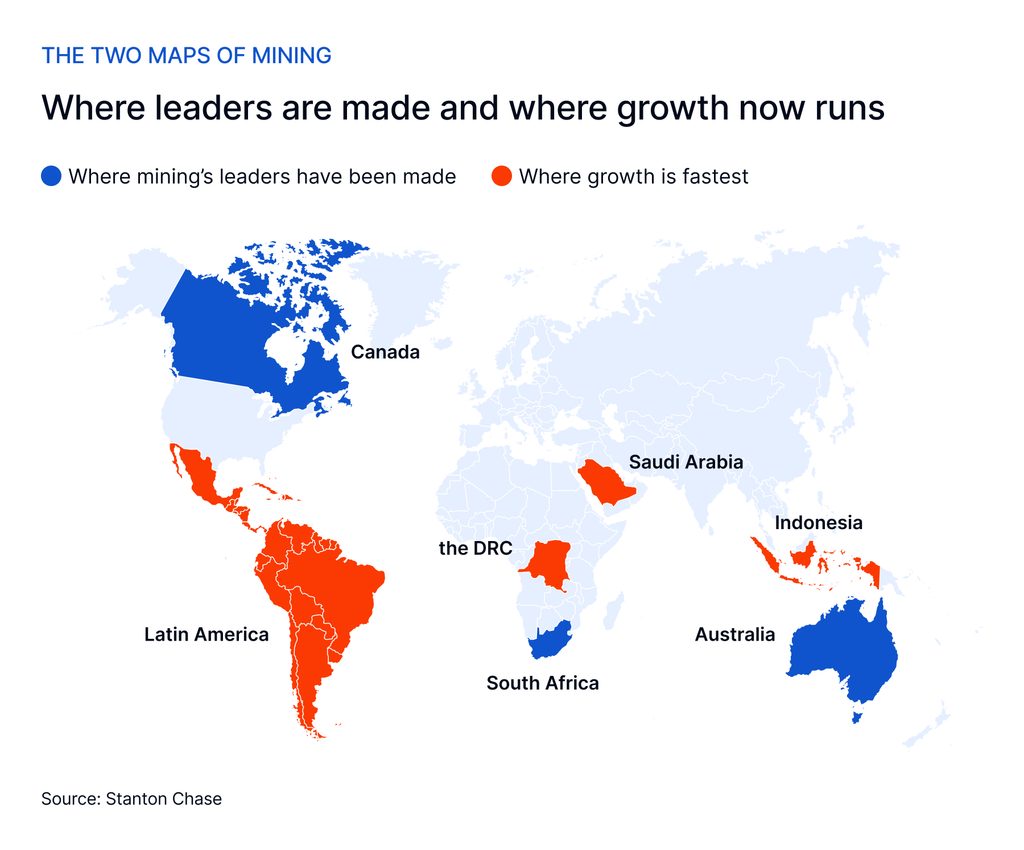
Where Are Mining’s Leaders Made?
Australia, Canada, South Africa, and the United States built the route to mining leadership. Each had a mining sector big enough to give a young engineer a whole career. Universities taught geology and mining engineering at scale, and employers moved people from mine to mine and from country to country as a matter of course. A graduate began as a geologist or a mining engineer and rose through mine management. A generation later, the same person was running a company. The route was so reliable that the rest of the industry never needed one of its own.
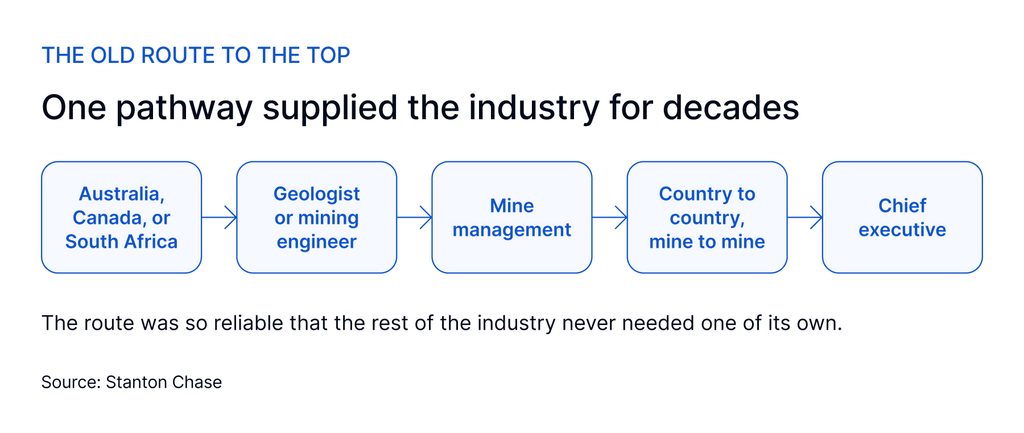
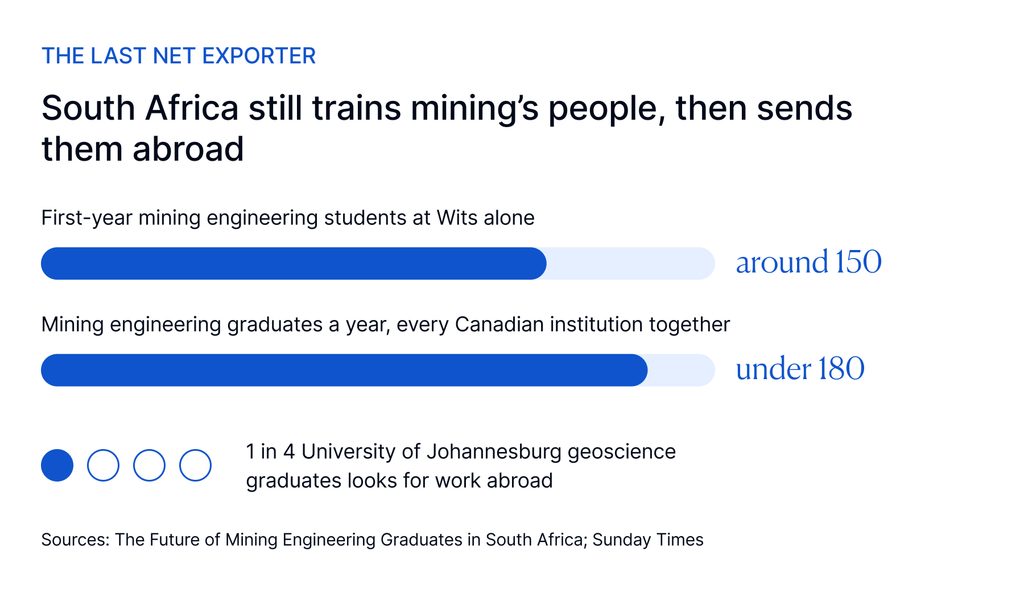
Australia and Canada are now training far fewer people for it. McKinsey counted a 63% fall in Australian mining engineering enrollments since 2014. The Australian Geoscience Council recorded a 40% drop in geoscience degree completions over eight years, and fewer than half of the country’s 42 universities still offer the subject. The fall comes as demand rises, with the employers’ association AREEA counting 107 projects due to enter production by 2029 that will need about 26,810 operating staff. Canada, which once supplied the other great share of the industry’s engineers and geologists, is on the same slope, and it was already leaning on imports, since nearly 30% of Canadian geoscientists were born abroad. Enrollment in core geoscience and geological engineering programs fell 50% between 2015 and 2022, and the number of mining engineering graduates dropped by about a third between 2016 and 2020, from roughly 260 to 174. Every Canadian institution together now produces fewer than 180 mining engineering graduates a year. The University of the Witwatersrand in Johannesburg alone registers around 150 first-year students.
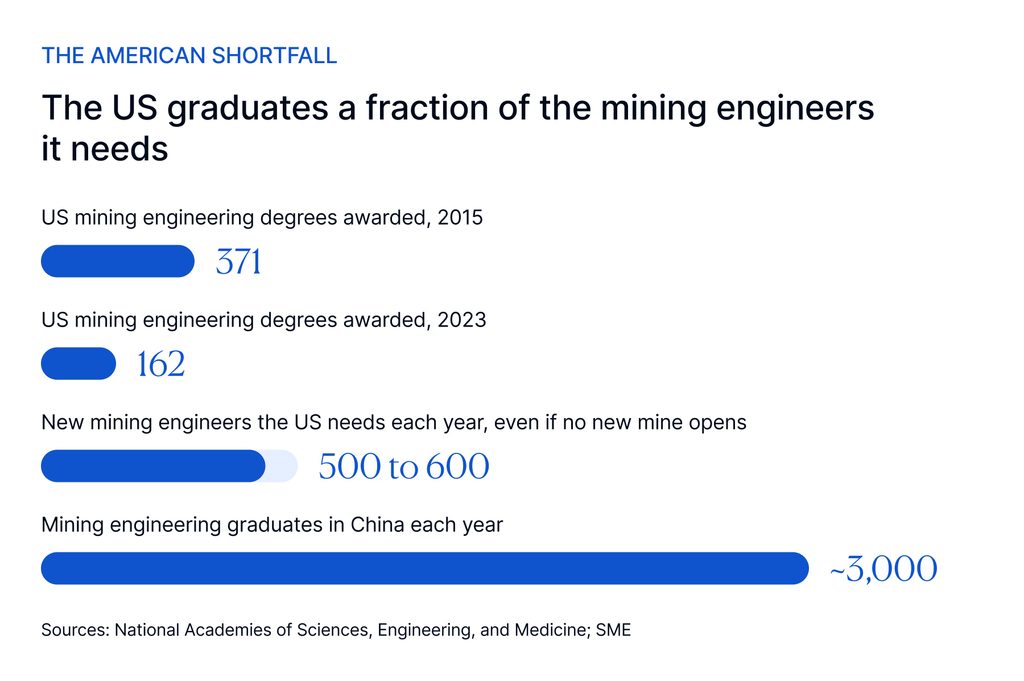
The United States tells a similar story, and a starker one against demand. The National Academies found that US mining engineering programs enrolled 1,449 undergraduates in 2015 and 590 by 2023, a drop of about 60%, while degrees awarded fell from 371 to 162 a year across the country’s 14 programs, an average of 12 graduates per school. The Society for Mining, Metallurgy & Exploration estimates the country needs 500 to 600 new mining engineers a year even if no new mine ever opens, and the Bureau of Labor Statistics projects about 400 openings a year for mining and geological engineers. China, by contrast, runs 45 mining engineering programs producing roughly 3,000 graduates a year, about 16 times the American output. Washington has noticed, with the Department of Energy putting the sector’s need at some 6,000 new engineers over the next decade and setting a goal of doubling graduates within two years.
South Africa, as the Wits number suggests, is the exception, and only in part. Its universities still turn out mining engineers and geoscientists in numbers. That makes it the last net exporter of mining talent among the four. The export is the problem, however. One in four of the University of Johannesburg’s roughly 300 geoscience graduates a year looks for work abroad. The Minerals Council’s head of skills development told a conference in February 2026 that the country is losing a lot of skills. A SAIMM paper was already describing the reversal in 2013. South Africa once recruited overseas graduates to cover its own shortfalls. Now it sends its best-educated mining professionals out to cover everyone else’s.
Where Is Mining Growing? New Frontiers, New Challenges
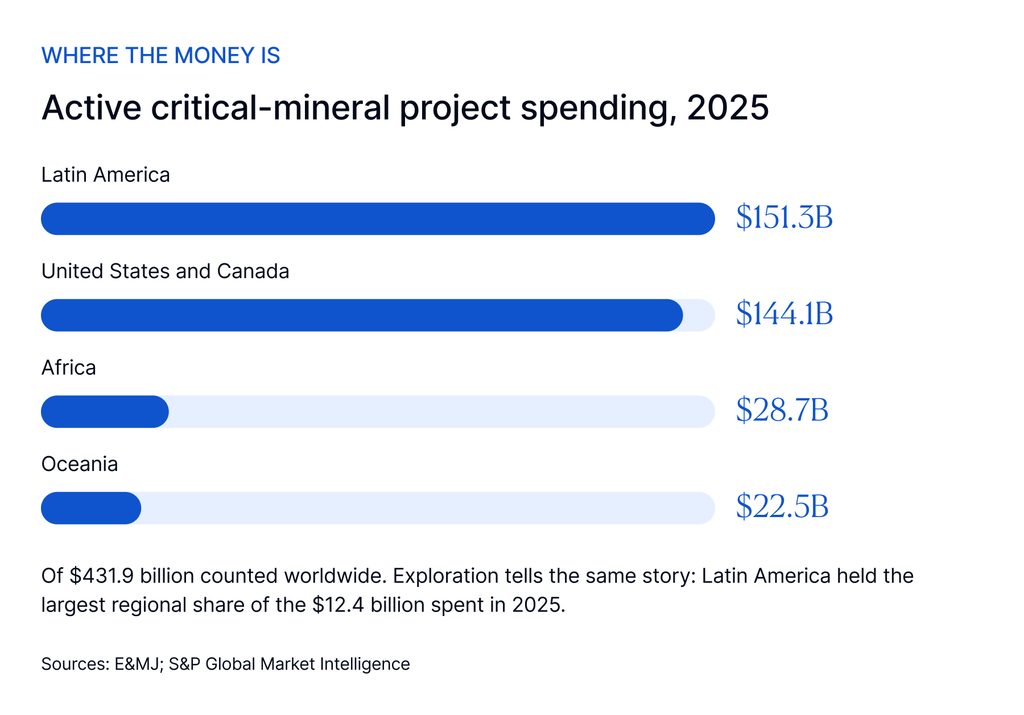
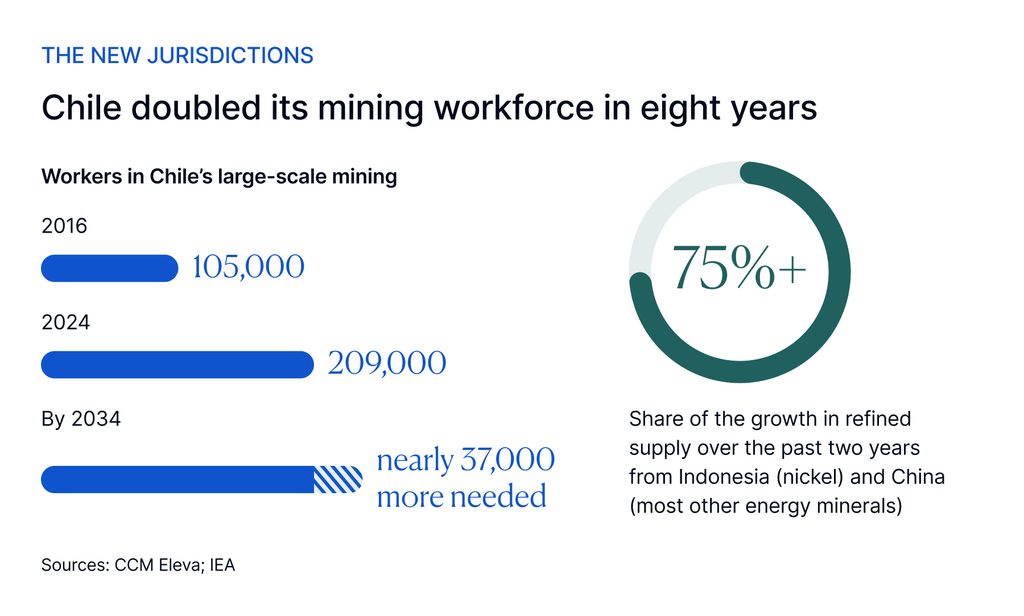
Follow the globally mobile engineers and geoscientists and you find the answer, because mining’s major new frontiers of growth have mostly moved outside the four countries that have traditionally trained its key technical staff. S&P Global Market Intelligence’s World Exploration Trends 2026 ranks Canada as the largest single exploration destination. Latin America, though, holds the largest regional share of the $12.4 billion spent worldwide in 2025, Saudi Arabia and parts of Africa posted the notable increases, and Australia had a mixed year in which higher gold spending was offset by steep declines in lithium and nickel. Project spending repeats the ranking at larger scale. Of $431.9 billion in active critical-mineral projects counted by E&MJ in 2025, Latin America held $151.3 billion and the United States and Canada $144.1 billion. Africa held $28.7 billion and Oceania $22.5 billion. Chile alone has doubled its large-scale mining workforce from 105,000 in 2016 to 209,000 in 2024 and expects to need nearly 37,000 more by 2034.
The supply side tilts harder toward the new frontiers. The IEA’s 2026 critical minerals outlook reports that Indonesia for nickel and China for most other energy minerals accounted for over three quarters of the growth in refined supply over the past two years. Its 2025 edition traced mining growth to the Democratic Republic of the Congo for cobalt and Indonesia for nickel. Much of the new lithium came from emerging producers such as Argentina and Zimbabwe. Indonesia, the DRC, and Argentina are not places where mining’s leaders have historically been trained, and investment in those countries has been sporadic and highly dependent on commodity cycles. Exploration by its nature chases new frontiers, in geology and in scientific technique, and together with commodity trends that has brought huge investment in exploration and M&A to the Americas over the last decade. This has been largely true of copper and gold, as well as rare earths and lithium.
The result is that many more mining companies, large and small, now operate well outside their traditional homes and meet political, economic, and regulatory systems unlike their own. Some resemble the common law architecture of the West. Others are remnants of French and Belgian colonial law, and others again rest on Spanish precedent modernized to suit local conditions. The geology in these places is very good. The difficulty is that states with no history of common law can be hard going for companies used to enforceable property rights, and that difficulty sharpens when it meets economic nationalism. Emerging jurisdictions asserting sovereignty over their mineral wealth is nothing new, but it is coming into sharper focus in Africa, eastern Europe, and parts of Southeast Asia, where western companies are under growing pressure to partner with national governments to develop assets, or to part with those assets in favor of another buyer or operator. All of this is part of a geostrategic competition for resources now underway in earnest across the world.
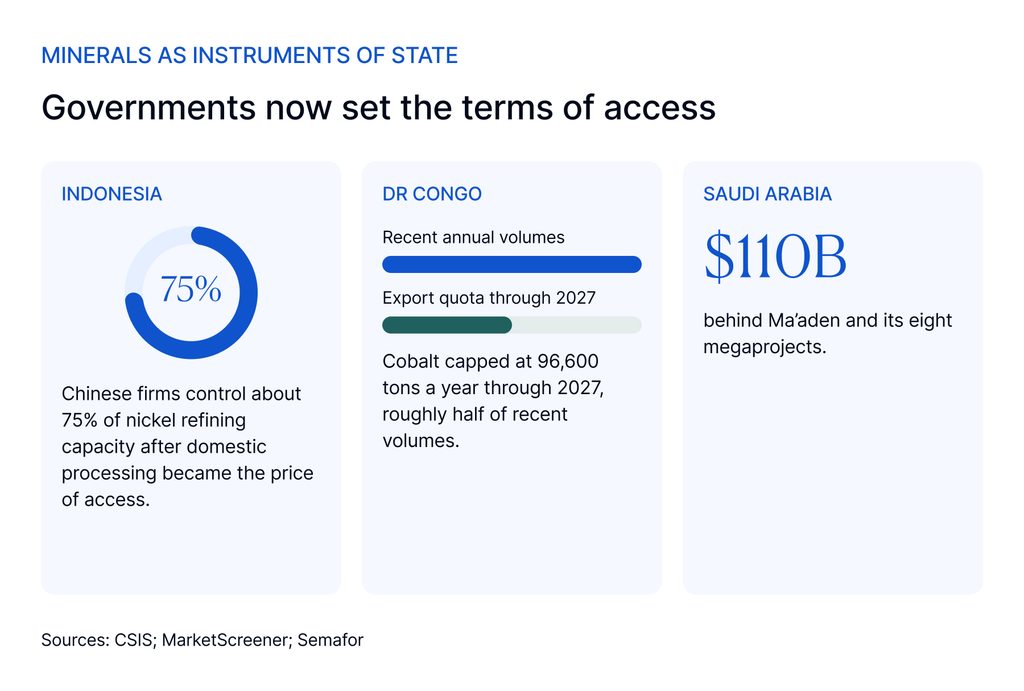
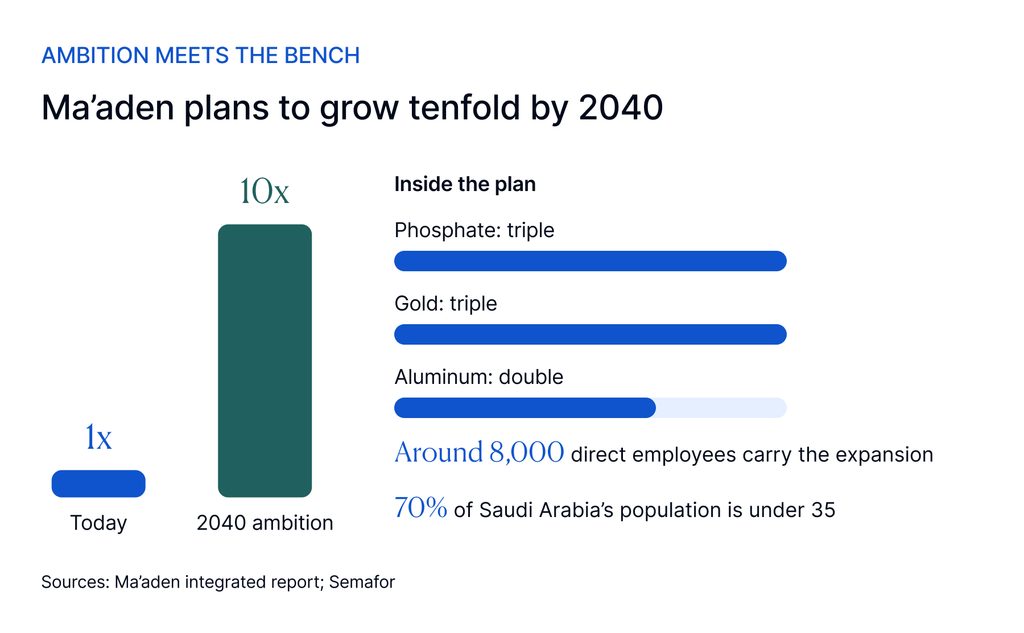
Leadership at executive and operational level is caught in that pincer, and the results are plain to see. Jakarta made domestic processing the price of access to its nickel, and Chinese firms now control about 75% of the country’s refining capacity. Kinshasa banned cobalt exports outright in February 2025, then swapped the ban for quotas that cap shipments at 96,600 tons a year through 2027, roughly half of recent volumes. Saudi Arabia is putting $110 billion behind Ma’aden and its eight megaprojects, part of a plan to grow the company tenfold by 2040. These are not merely resource-rich states hosting outside operators. They are building the industrial and human capital to own the industry outright, and they set the terms on which outsiders arrive to run it.
Saudi Arabia shows how far the ambition runs, and how thin the bench beneath it is. Ma’aden’s plan would triple the phosphate and gold businesses and double aluminum, while the company moves into copper and rare earths. All of this rests on around 8,000 direct employees. The Kingdom’s own Vice Minister for Mining has spoken of a serious lack of trained and experienced people, with many of its geologists and engineers close to retirement and no one coming up behind them. Ma’aden’s chief executive describes a war for talent. Mining competes with tourism and entertainment for a population that is 70% under 35. For now, the Kingdom has to compete globally for experienced people while it builds its own. In practice that means importing the project directors and executives its megaprojects need.
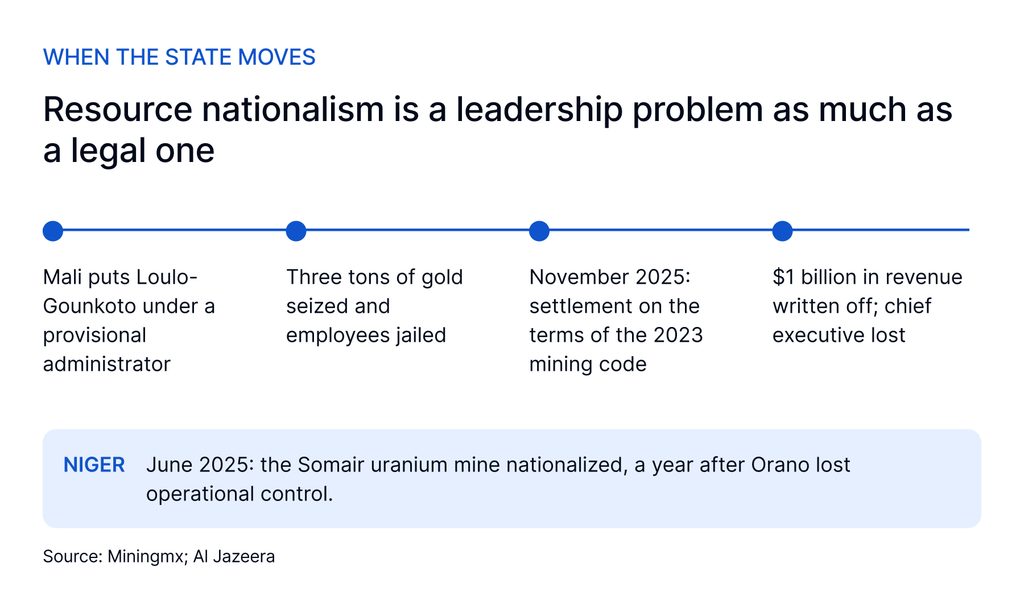
The other side of state direction is what a state can do once the capital is sunk. Mali put Barrick’s Loulo-Gounkoto complex under a provisional administrator and seized three tons of its gold. Employees were jailed. The dispute ended with a settlement in November 2025 that returned the mine to Barrick on the terms of the country’s 2023 mining code. By then the company had written off $1 billion in revenue and lost its chief executive. Niger nationalized the Somair uranium mine in June 2025, a year after stripping Orano of operational control. Each case makes capital warier of every project in its region. Each also turned on relationships that a leader without standing in the country could not hold. Resource nationalism is a leadership problem as much as a legal one.
Much of this new frontier sits in Asia outside China, in the Gulf, and in the Americas outside Chile and Peru. Saudi Arabia’s listed but state-directed Ma’aden sits with the political and economic rest for the same reason Indonesia and the DRC do: mining there answers to the state, not to international or public shareholders, wherever it sits on the map. The line that counts runs between capital systems, not meridians, and on that line the political and economic rest is increasingly training and promoting its own leadership rather than importing it from the West.
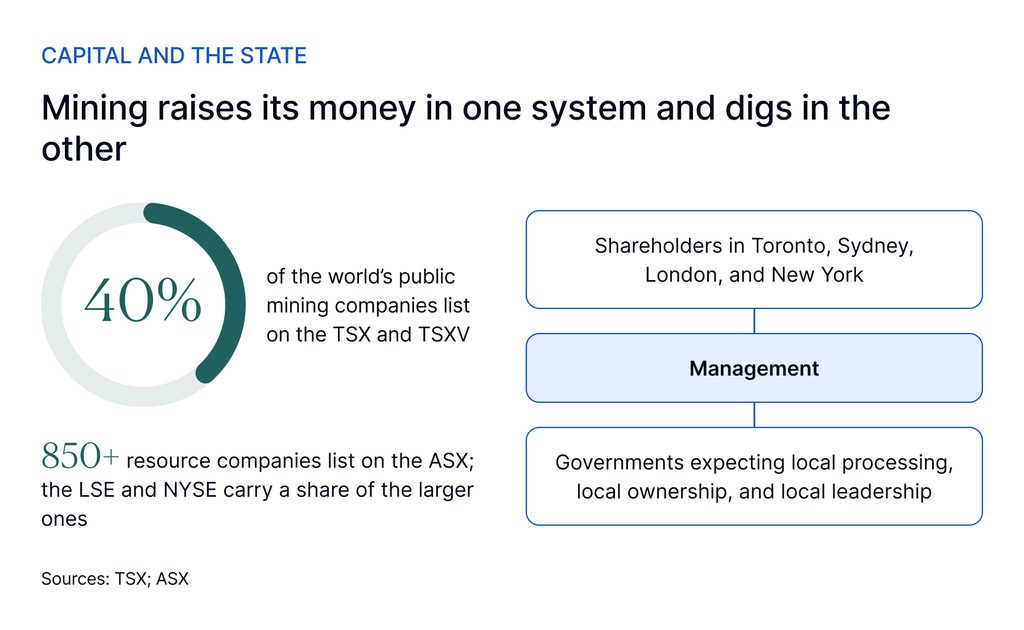
A company that raises its money in one system and digs in the other feels that split in its boardroom. Mining remains a public-market industry, and its listings are concentrated. About 40% of the world’s public mining companies are listed on the TSX and TSXV. More than 850 resource companies are listed on the ASX, and the LSE and NYSE carry a share of the larger ones. Shareholders in Toronto, Sydney, London, and New York have settled expectations of how a company is governed and who should run it. The exchanges write those expectations into their rules. A board must satisfy them while its operations answer to governments with expectations of their own, from local processing and local ownership to local leadership. Management stands between the two. The leader who can hold both sets of expectations at once has become hard to find.
What Happens When the Two Maps Diverge?
The industry has answered the mismatch between where its leaders are made and where its growth sits in three ways, and each was visible in 2026. The first is to import. In Indonesia’s nickel parks, the Carnegie Endowment found that Chinese employees hold the management and technical roles while Indonesians make up the workforce. Indonesian analysts were describing the same pattern in 2026. The importing runs to the very top. Saudi Arabia hired a very high-profile American who spent 17 years at Alcoa to run Ma’aden’s expansion. Managers and leaders go to where the good opportunities are, and many good opportunities have moved outside the old mining heartlands.
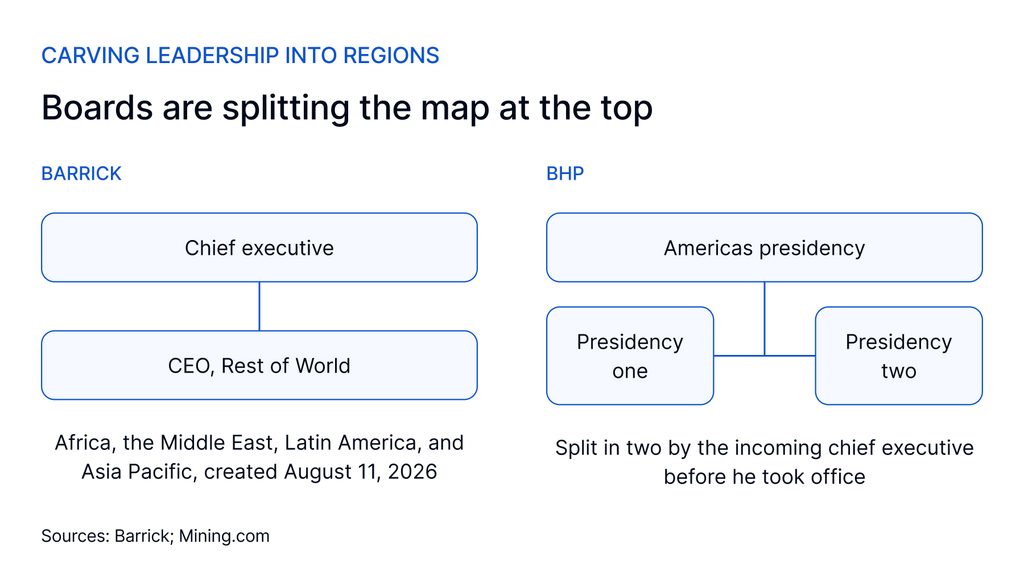
The second response is to carve leadership into regions. Barrick created a Rest of World chief executive on August 11, 2026, covering Africa, the Middle East, Latin America, and Asia Pacific. BHP’s incoming chief executive split the Americas presidency in two before he took office. A portfolio across four continents brings four sets of geology, regulators, communities, and politics, and a single chain of command running out of one head office often stops working under that weight.
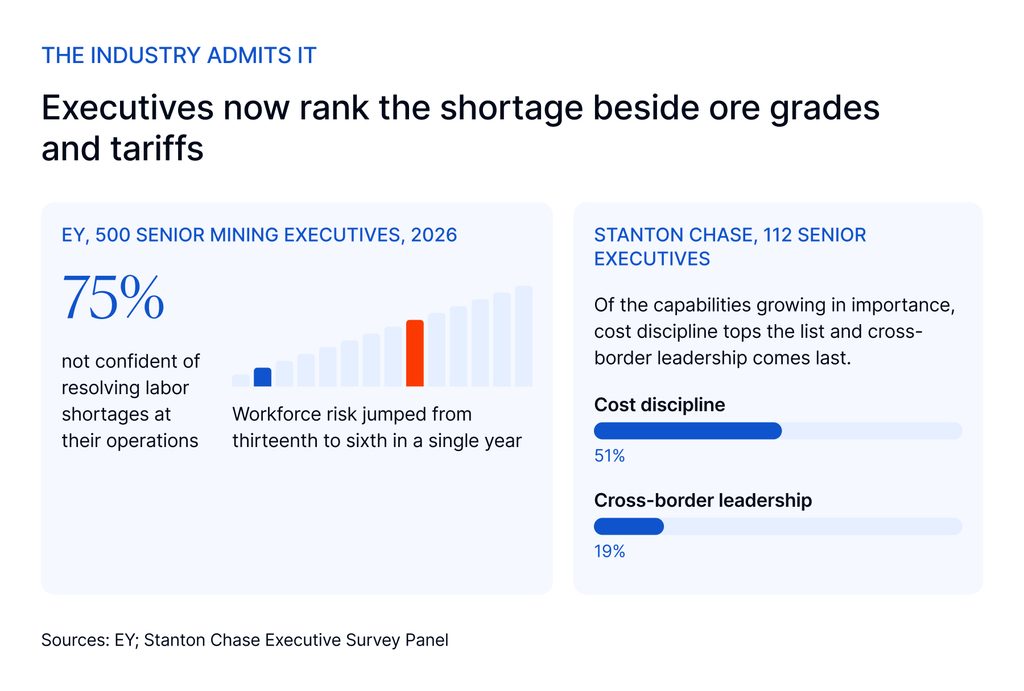
The third response is to admit the problem. In EY’s 2026 survey of 500 senior mining executives, 75% said they were not confident of resolving labor shortages at their operations, and workforce risk jumped from thirteenth to sixth in the ranking in a single year. The sector has known about its pipeline for a decade, and now ranks the problem beside ore grades and tariffs. Stanton Chase’s own survey of 112 senior executives on geopolitics and leadership adds a twist: cost discipline (51%) tops the list of capabilities growing in importance, while cross-border leadership comes last (19%). Mining’s growth now depends on the capability at the bottom of that list.
How Should Mining Companies Build Leadership in New Jurisdictions?
For mining companies, one practical solution is to grow leadership close to the geology rather than fly it in from a more established jurisdiction, and to admit why that has not happened already. Imported management can carry a new operation through its first decade, and few new operations could start without it. Indonesia’s nickel industry was built that way, and Ma’aden is being built that way now. The difficulty can arise in the second decade, when the expatriates rotate home and the local bench has not been trained to follow them. That moment keeps arriving because of the investment cycle. Long-term leadership programs are among the first costs cut when a commodity price turns. So the local bench gets built only where a company can see a decade of demand ahead, which in practice has meant copper more than anything else.
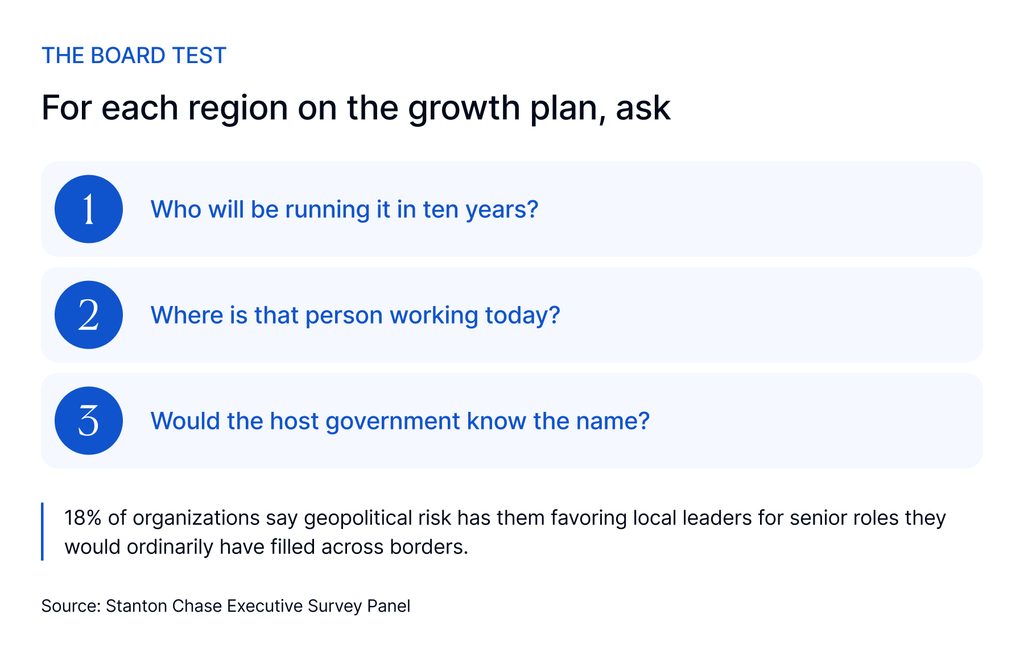
The way through is to stop treating local leadership as a training budget and to treat it as part of the license to operate. Host governments are moving that way already. States that write processing rules and export quotas to keep value at home will not leave the question of who runs the mine untouched. Companies can see it coming. In Stanton Chase’s Executive Survey Panel research, 18% of organizations say geopolitical risk has them favoring local leaders for senior roles they would ordinarily have filled across borders. A leadership pipeline that a government and a community can see, with named successors in the mine and in the country office, carries weight when a mining code is rewritten or a permit comes up for renewal. Shareholders have a stake in the same pipeline, since they pay for expatriate packages in the good years and for political risk in every year. So the bench needs building early, ideally years before the seats open, and protecting through the downturn as the asset-level investment it is. The older mining countries still have a large part to play, as training grounds where a growth region’s future leaders can spend part of their careers. A South African or Australian engineer who spends five years in Antofagasta or Sulawesi, working alongside a local successor, leaves more behind than one flown in for three years and flown home.
For boards, this is a question of risk. Where a company is growing, the geography of its future leadership deserves the same attention as ore grades, permitting, capital, and community consent, and the EY survey suggests directors are starting to see it that way. A useful test is to ask, for each region on the growth plan, who will be running it in ten years, where that person is working today, and whether the host government would know the name.
About the Authors
Greg Preston is Managing Director of Stanton Chase Perth and Denver. With over 20 years of experience in executive search, Greg focuses on senior technical, operational, and project leadership roles within the natural resources and energy sectors. His career includes a global strategic advisory role with a Tier One EPCM firm and consulting for major miners including BHP, Rio Tinto, and Vale across Australia, Southeast Asia, and the South Pacific. Greg has gained critical experience across a range of commodities including lithium (carbonate and hydroxide), copper, gold, rare earths, and nickel, making him exceptionally well positioned to assist clients navigating the leadership challenges of the energy transition.
Romina Remy Alcántara is a Principal at Stanton Chase Montevideo, where she leads executive search engagements at the managerial and C-suite level for local and international companies in Uruguay, Argentina, and Paraguay. She has more than ten years of experience in executive search, with searches across general management, finance, commercial, operations, marketing, and technology roles for clients in sectors that include mining and energy.
How Can We Help?
At Stanton Chase, we're more than just an executive search and leadership consulting firm. We're your partner in leadership.
Our approach is different. We believe in customized and personal executive search, executive assessment, board services, succession planning, and leadership onboarding support.
We believe in your potential to achieve greatness and we'll do everything we can to help you get there.
View All Services